Post
Where Uncensored Models Come From
I counted 3,352 uncensored releases of three base models and read their public weights. 177 are distinct work. What the rest are, what a fresh edit takes, what mine cost, and what the next one needs.
11 min readUpdated
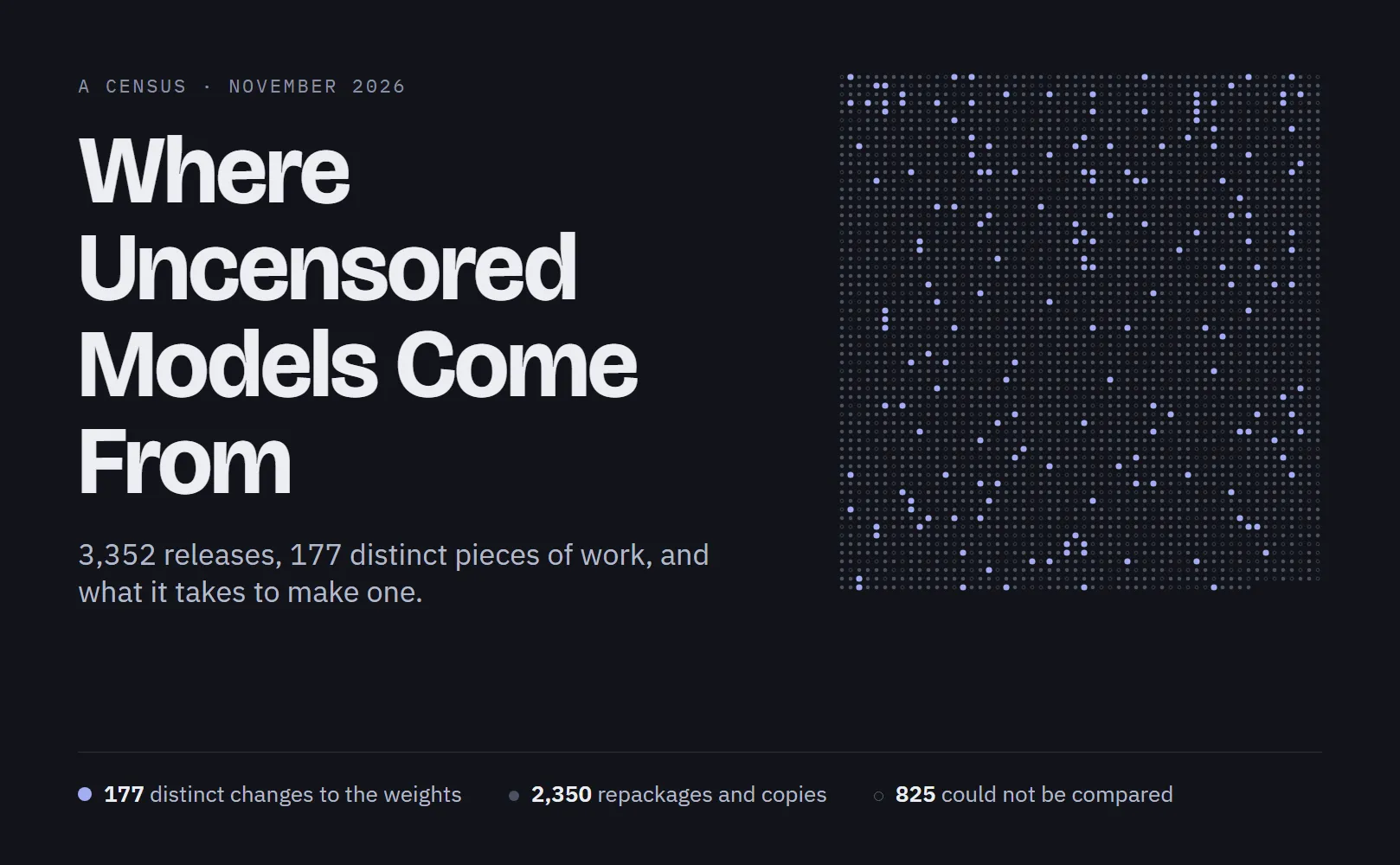
Every month, hundreds of new "uncensored" AI models appear on Hugging Face, the public library where open models are shared. Last month there were more than five hundred for just three base models. I make these models too, and each of mine takes days. People ask me why.
For a long time my honest answer was a hunch about how the others get made, and a hunch is not something to publish. So I counted.
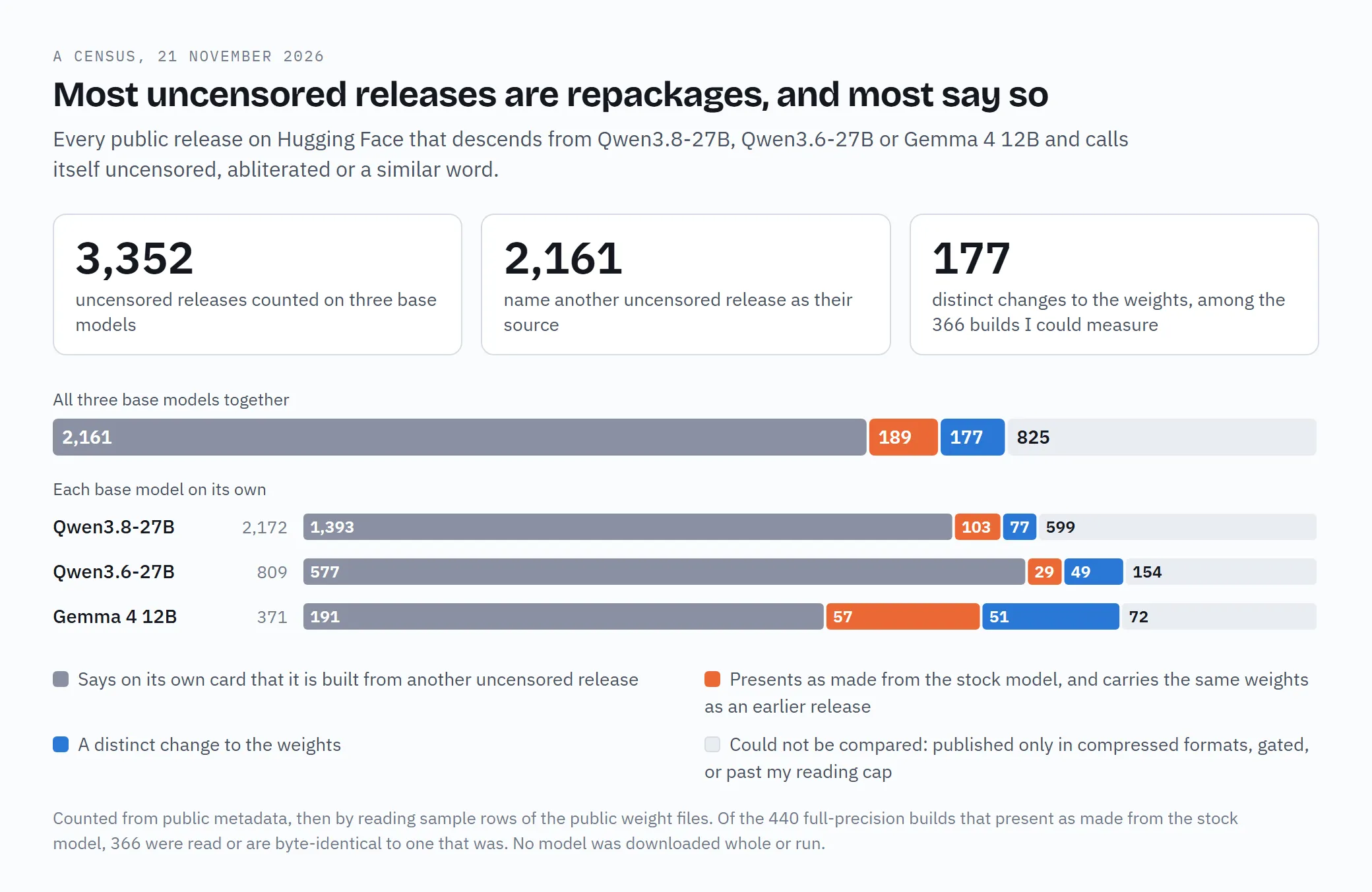
On 21 November 2026 I listed every public uncensored release that descends from Qwen3.8-27B, Qwen3.6-27B or Gemma 4 12B. There were 3,352. Then I read their public weight files to see how many are really different work.
The short version:
- Almost two in three, 2,161 of the 3,352, say on their own card that they are built from another uncensored release.
- Among the builds I could measure, 177 are distinct changes to the weights.
- Most copies name their source.
- I expected nearly everything to trace back to one or two edits. I was wrong about that.
What I counted
An uncensored model is an open model that has been edited so it stops refusing requests. The usual method is called abliteration: find the direction inside the model that carries refusal, then subtract it from the weights, the numbers that are the model.
A release counted if it descends from one of the three base models and its name or tags say uncensored, abliterated or something similar. The 3,352 fall into four kinds.
Declared repackages: 2,161. The card names another uncensored release as its parent. These are conversions to other formats, compressed builds for smaller machines, and merges or fine-tunes built on top.
The same weights as an earlier release: 189. These present themselves as made from the stock model, the original as its maker released it. But their full-precision weights match a release that came first.
Distinct work: 177. That is 134 targeted edits and 43 broader changes, such as retrains and merges, that match nothing earlier.
Could not be compared: 825. These are published only in compressed formats, sit behind an access gate, or fell outside the limit I set on how much to read.
So distinct work is somewhere between one release in nineteen and three in ten, depending on what the unmeasured ones turn out to be.
I name no publisher in this article, on purpose. This is about what to look for, not who, and anyone can check a release against its public files.
Nobody here is a villain
Repackaging is a service. Someone has to make the build that fits a laptop or one particular GPU. Four of my own releases are exactly that: another maker's edit, compressed for hardware I care about, with their name on the card.
Credit is the norm too. Of the 203 copies I checked, 170 name their source in the README.
Some makers have told me outright how they work. They download a model that is already edited, look at which weights changed, make the same changes, and publish under their own name. I respect them. They are learning, they believe they are doing good work, and a name on a project is how it gets noticed. It is a grey area, and I am not here to condemn it. I am here to show how mine are made.
What people miss, I think, is how easy it is to skip the work without meaning to. I build with AI agents. Ask an agent for an uncensored model and it looks for the shortest path, which starts from weights someone else has already edited. Mine tried it once, and I stopped it. We do not build on someone else's edit. We make the best one we can, to our own bar for quality. I doubt everyone catches that moment, and I will not assume anything about the people who did not.
Tools leave a similar trace. In 18 cases, two edits by different makers point nearly the same way at different strengths. That is what you would expect from two people running the same open tool on its default prompts. Neither copied the other.
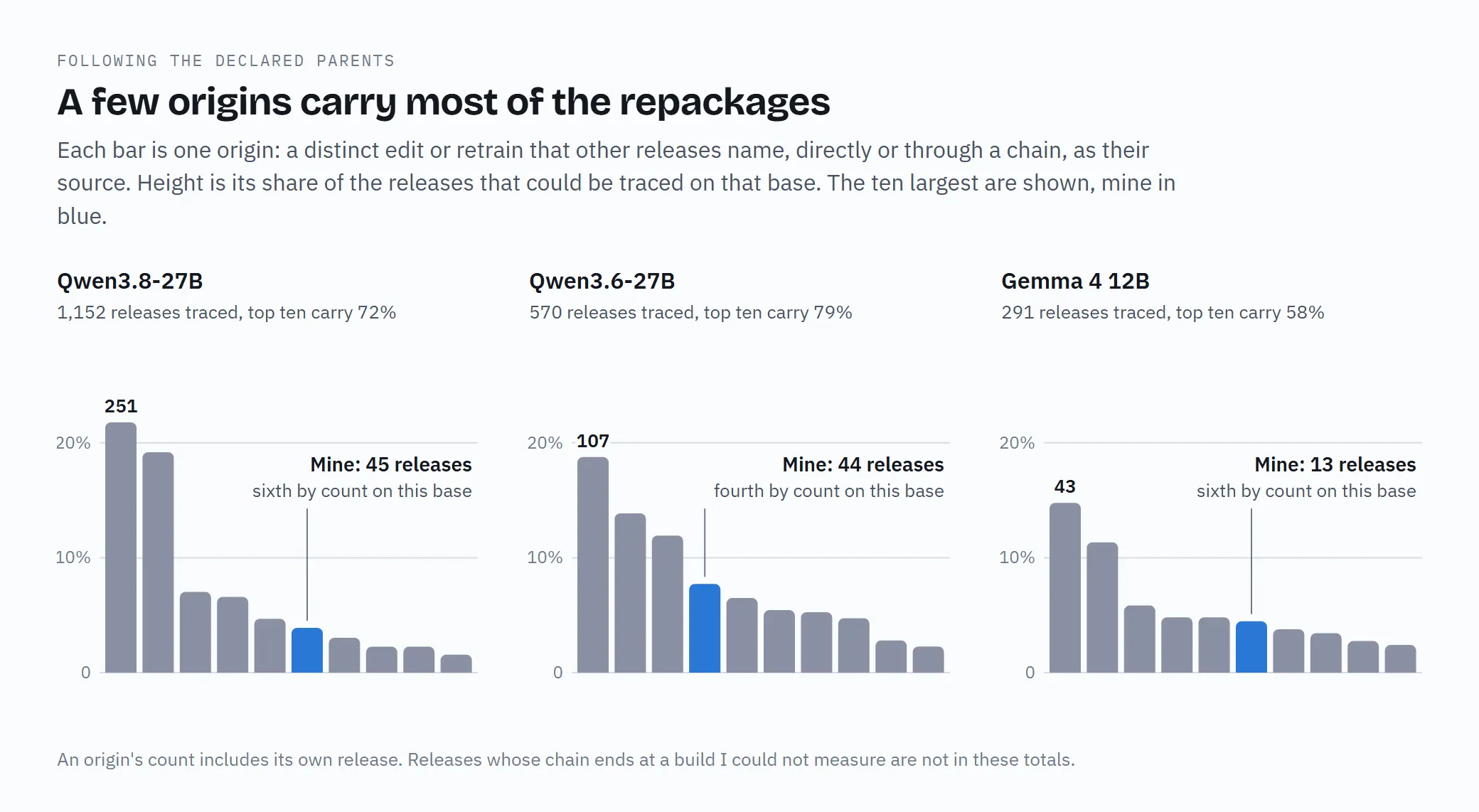
So the edits are not what is concentrated. What gets built on them is. On each base model, ten origins carry between 58 and 79 percent of the releases I could trace. My edits are among those origins. Each is computed from the stock model, and anyone is welcome to build on them or train from them, as others already do.
What a fresh edit takes
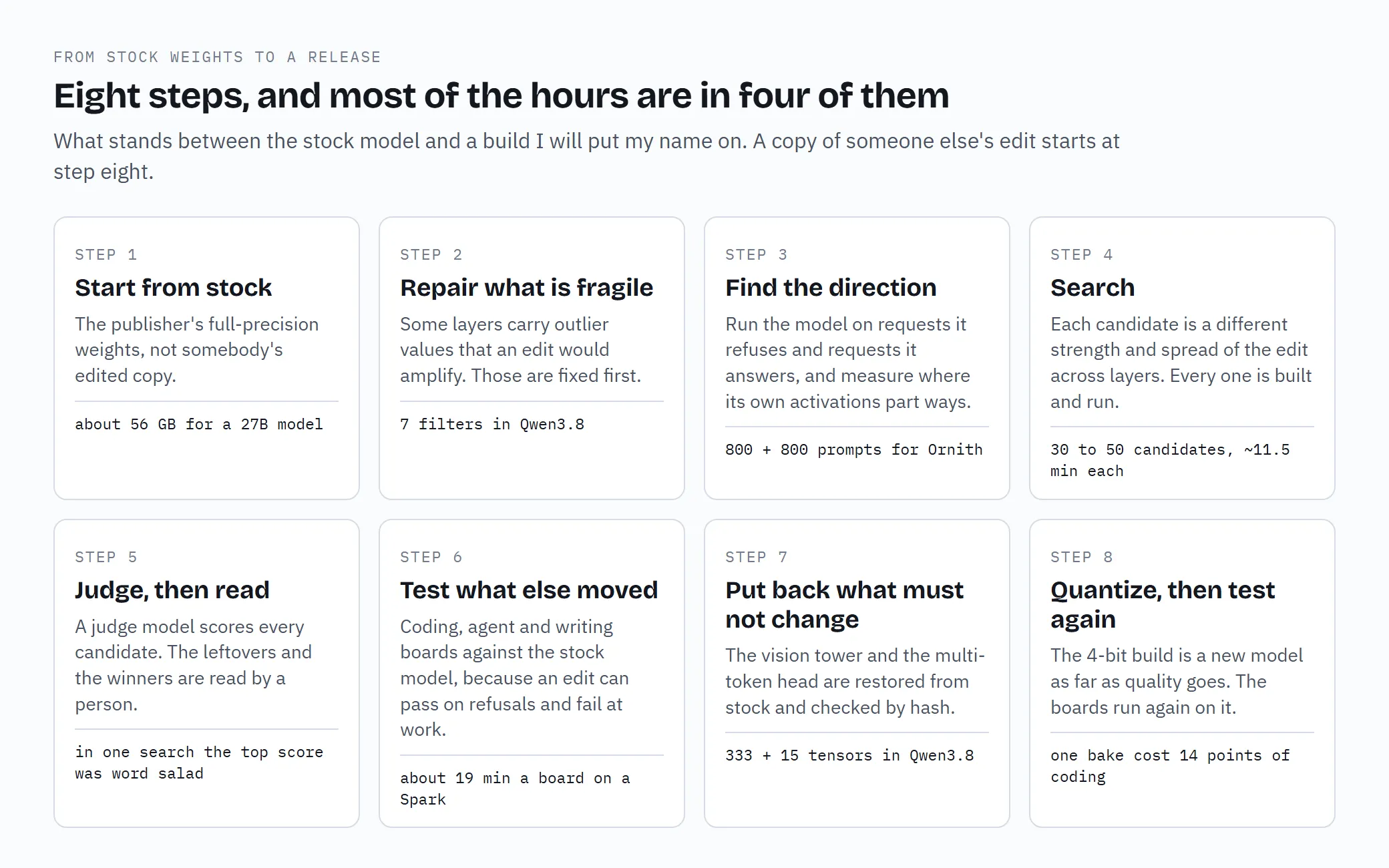
Most of the hours go into the search. Each candidate applies the edit at a different strength and spreads it differently across the model's layers, and every one has to be built, run and scored.
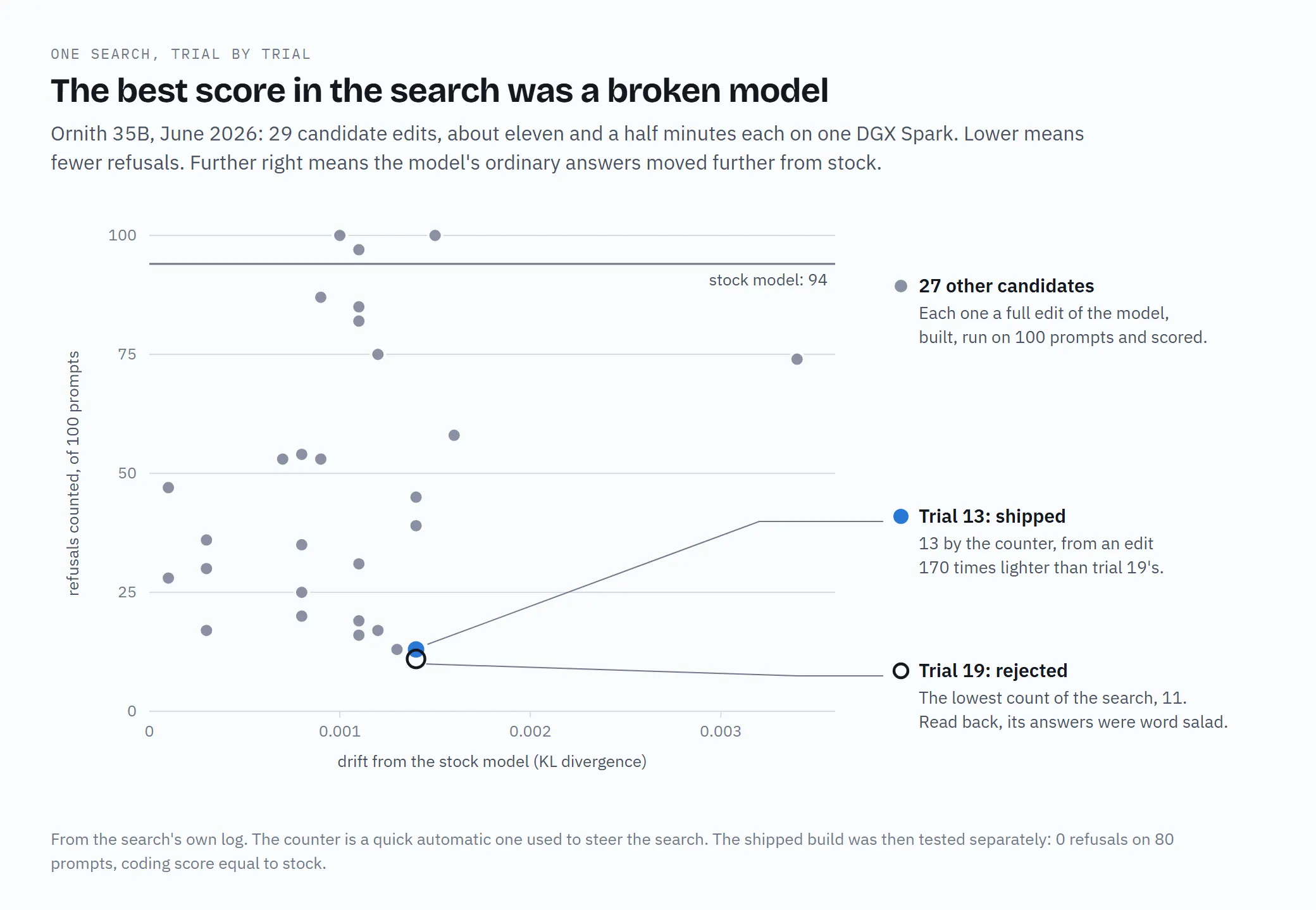
In that search, the candidate with the fewest refusals was unusable. Its answers were word salad. A pipeline that ships the top score ships that model.
Scores mislead in the other direction too.
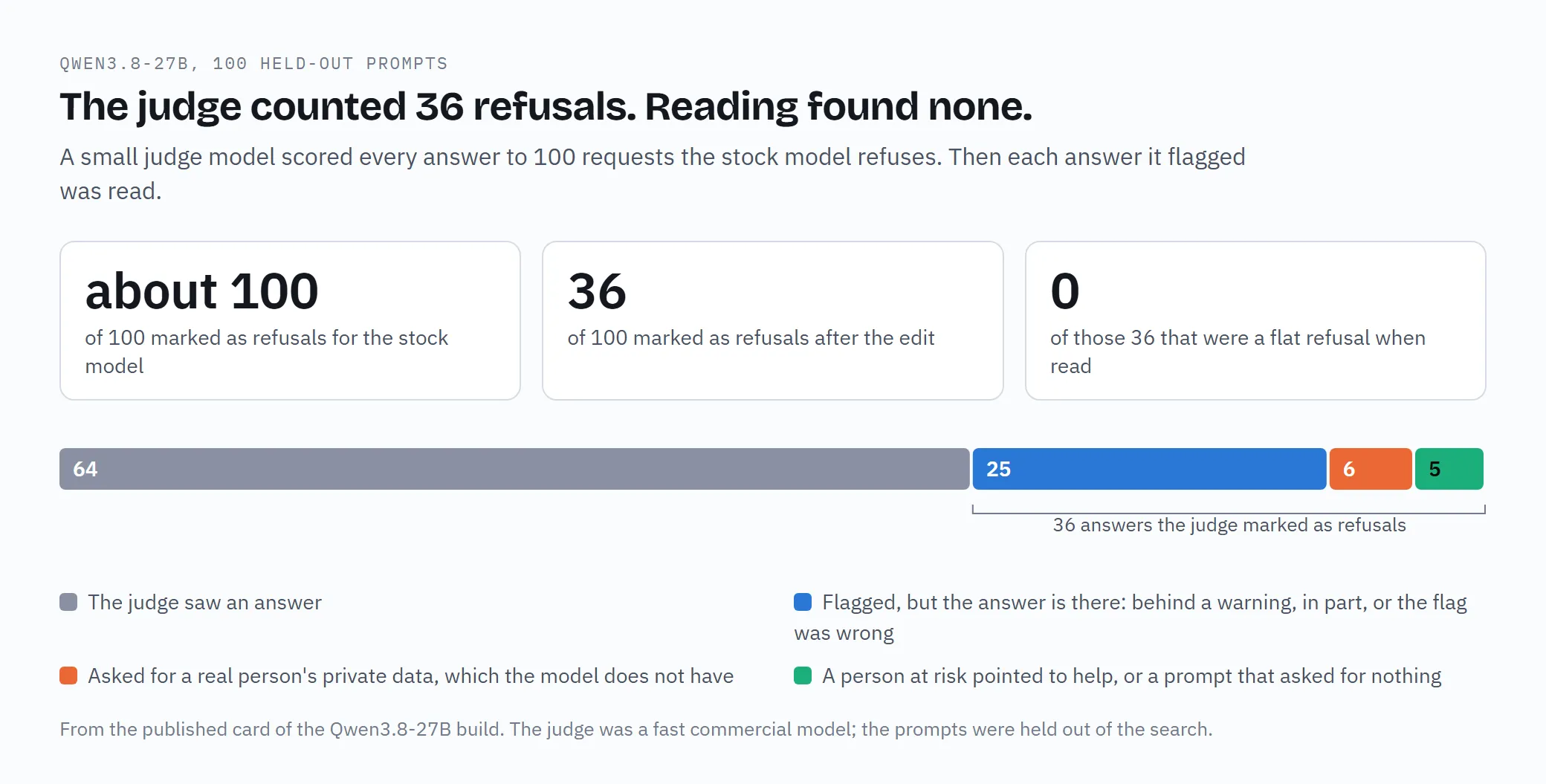
Here an automated judge counted 36 refusals in 100 answers. Read one by one, none of the 36 was a flat refusal.
Zero refusals is easy if you do not care what is left. My bar is zero refusals with the model still able to code, reason and write. So every build runs the same test boards as the stock model, before it is compressed and after. One compressed build of Qwen3.8 scored 14 points lower on coding until I changed which layers kept more precision.
You can check my edit
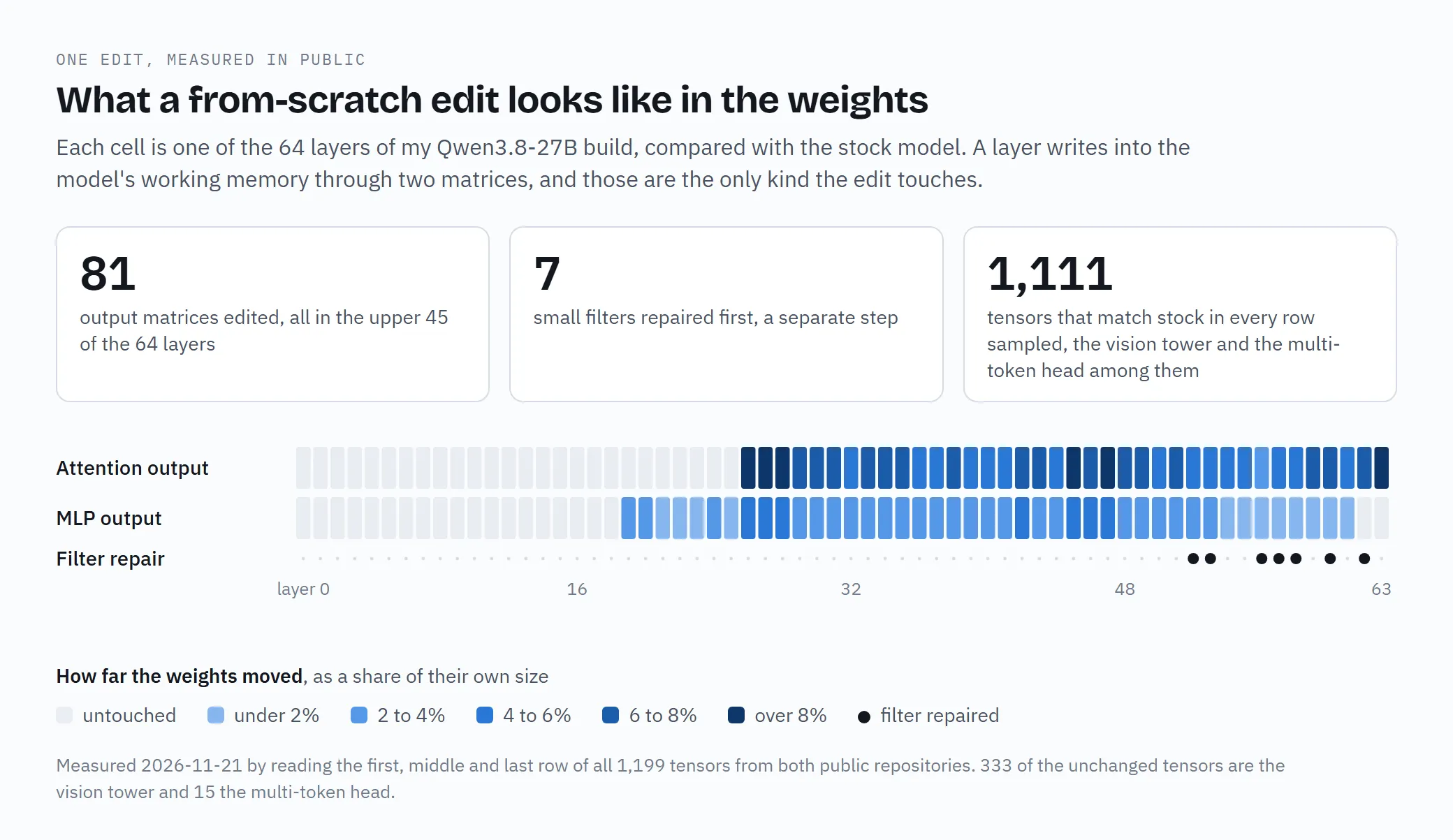
This is my Qwen3.8 edit, read straight from the public files: 81 output matrices changed, 7 small filters repaired, 1,111 tensors untouched. You do not have to take my word for any of it.
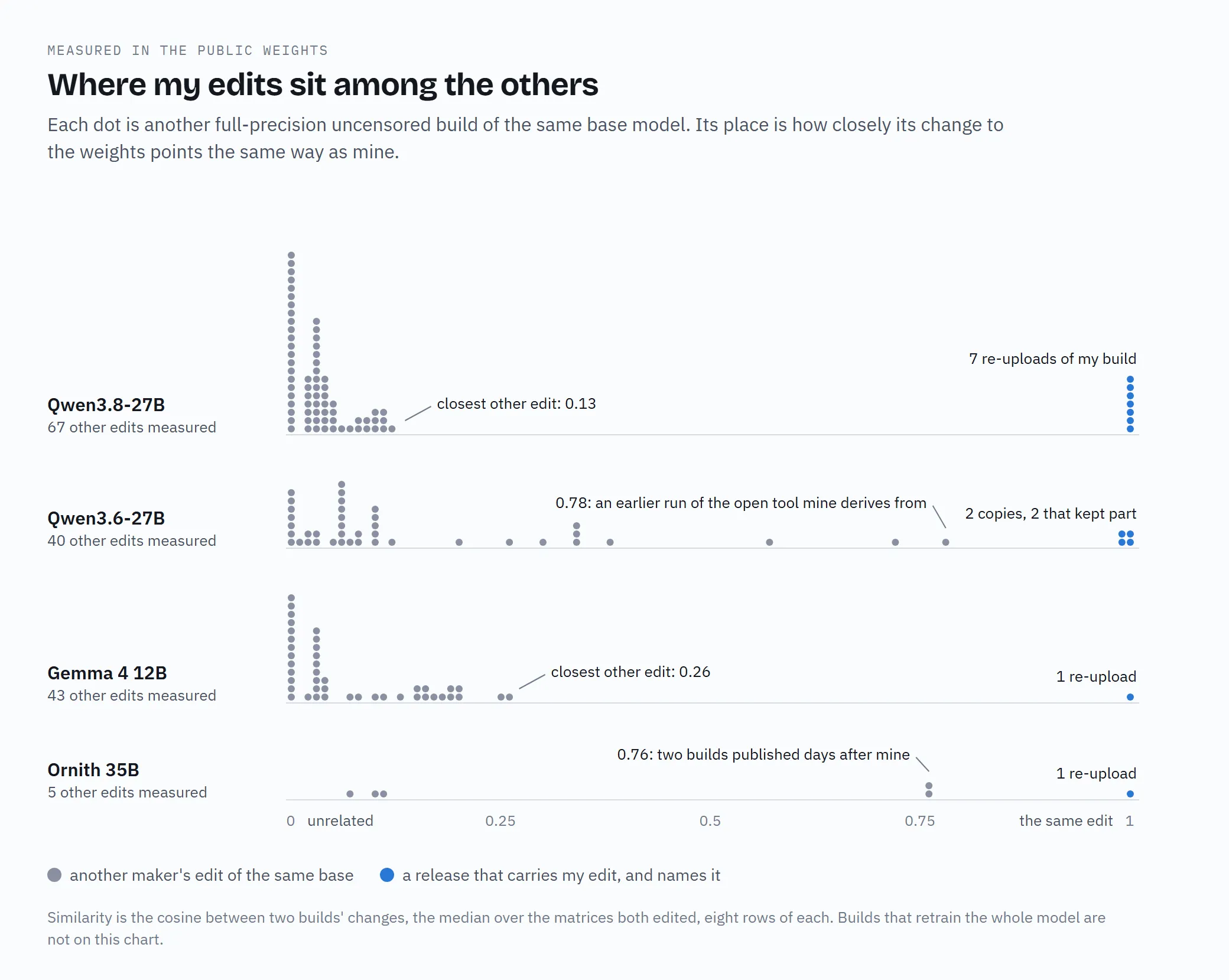
On Qwen3.8, the closest edit by anyone else scores 0.13 on a scale where 1 is the same edit. Seven accounts have re-uploaded that build byte for byte, and all seven name it.
Two things keep me honest here. First, I did not write the tools. The edit is computed fresh from the stock model, but with abliterix, an open tool that derives from Heretic. My Gemma build extends another maker's recipe, and says so. Second, on Qwen3.6 my edit sits at 0.78 from a Heretic build published the day before mine. The same family of tools found a similar direction. That is not a copy, but it is not as independent as the Qwen3.8 edit either.
What it costs
Most of the real jobs ran on rented data-center GPUs, which is why doing it this way is expensive. I do not have a clean ledger for all of it, and I will not invent one. These are the pieces I can put a figure on.
| What | What it took |
|---|---|
| One search, Ornith 35B | 29 candidates at 11.5 minutes each: 5.6 hours on a DGX Spark I own |
| One search, Qwen3.6-27B | 50 candidates, about 4 hours on one RTX PRO 6000 |
| Ornith 35B, rented time for the whole job | about $100. The export and 8-bit build alone was about $10 on an H200 |
| Step 3.7 Flash | about $1,000 of rented time, and it needed more. The edit ran on four B200s |
| My Qwen3.8-Flash-Next build, releasing soon | over a week of constant running on a cluster of four DGX Sparks |
| One test board | 19 minutes for 157 cases on a DGX Spark |
| Renting an H200 | $3.59 to $4.39 an hour |
| Renting a B200 | about $5.90 an hour |
| Renting a B300 | $6.94 to $7.39 an hour |
Four B200s cost about $24 an hour, so $1,000 buys forty hours at most. For Step 3.7 that was not enough. Doing a model that size well takes more trials than the money bought, and some of those hours produced nothing I could ship: its 4-bit and 3-bit builds came out garbled. A failed run costs the same as a good one.
A 27B model fits on one machine I own. The larger models people are asking for next take a cluster or rented GPUs, for days at a time.
And the bill climbs faster than the model grows. A bigger model needs more GPUs at once, more days on them and more trials to tune, and those multiply. The full run I have planned for Qwen 4 27B is 2 B300s for 14 days. For DeepSeek V4.1 Flash, at 763 billion parameters, it is 48 B300s for 30 days. B200s and B300s are not always available to rent in those numbers.
What is not finished
- The cards for my Qwen3.8 build are out of date. The build is fully released, and the looping its card describes turned out to be a serving configuration problem that the stock model shares. With corrected startup settings it runs well, and on AEON Bench, my own benchmark, the official compressed build scores 89 for intelligence against 85 for a 4-bit build of the stock model. It still trails stock on reasoning, 77 against 86.
- My older cards scored refusals by keyword, which I trust less than a judge plus reading. The Step 3.7 card has no measured refusal rate yet.
- The census cannot see inside compressed builds, and that is where most downloads are.
- For very light edits, rounding can make one edit look like two, so for those the count of distinct edits is an upper bound.
What I am asking for
Everything stays open: weights, cards and method. Subscriptions are what keep it going, and you can subscribe here.
Next out is my Qwen3.8-Flash-Next build. In my testing, which included long-context pressure tests, it loops less than the stock model and scores slightly above it on some capability benchmarks. It also drifts very little from the stock model: a KL divergence of 0.0008 on my test prompts, where 0 means no drift at all. The full numbers will be on its card at release.
The next builds each have a page with their numbers: Qwen 4 27B, Qwen Next Flash, MiniMax M3.1 Flash and DeepSeek V4.1 Flash. Qwen 4 27B is $3,800 for the light run and $16,100 for the full one.
A lot of what I have done was possible because Todd Wright (@ToddWright_ on X), a member of this community, contributed compute. If you run a cluster with idle hours, compute is worth more to this work than money, and I would like to hear from you.
Method
I used the public Hugging Face API and public files only. No model was downloaded whole or run.
Who counts. Every release that descends from one of the three base models, found through the parents each card declares and through a name search, whose name or tags match a list of words: uncensored, abliterated, heretic, obliterated and similar.
What was read. For each full-precision build that presents as made from the stock model, most downloaded first and up to 80 distinct builds per base: the first row of every matrix, compared with the stock model, then eight rows of every matrix that changed.
Same or different. Two builds are the same edit when their files have the same hashes, or when they change the same matrices in the same direction, cosine 0.98 or more, at the same strength. A similar direction at a different strength counts as separate work.
Credit. A text search of each copy's README for the name of the release that came first. It can miss credit given elsewhere.
Correction, 22 November. The first version of this article said one release that calls itself abliterated matched the stock model. That was my error. The release adds one neuron to every layer and leaves the existing weights as they are, and my first pass skipped matrices whose shape had changed. It is real, distinct work and is now counted that way, which moved the count of distinct work from 176 to 177.
More like this
- Qwen 3.8 27B AEON Ultimate: the current flagship and how to serve it
Qwen3.8-27B AEON Ultimate Uncensored is the model I now serve on one Spark, two Sparks and the RTX box: what coherent abliteration removes and keeps, the NVFP4-MIXED weight lattice, the three seat recipes with their commands, and the rules that keep them running.
The Aeon Forge14 min read - A Language Made of Ideas: Glyph Map of Meaning, part two
One symbol per sentence failed. So we went back to the oldest trick in writing: signs combined by rule, with meaning carried by where they stand. The new design, its 96 signs, and what we know so far.
The Aeon Forge16 min read - Glyph Map of Meaning: first results
Can one symbol carry a sentence's meaning across four languages, and can a small model read it back? What held up in the first round, what didn't, and what I'd change.
The Aeon Forge10 min read - Ornith 1.0 35B AEON Ultimate keeps the coding and drops the refusals
I abliterated DeepReinforce's Ornith 1.0 35B, an agentic coding MoE, and kept the coder: 0 of 80 refusals, pass@1 identical to the base, a three-way BF16, NVFP4 and DFlash benchmark on a DGX Spark, and the quick start to serve it.
The Aeon Forge10 min read - Nemotron 3 Nano Omni AEON Ultimate, served uncensored on a DGX Spark
An abliterated Nemotron 3 Nano Omni that reasons over text, images and audio on one DGX Spark. How the twelve-dimension refusal removal was found, what NVFP4 costs against BF16, what the source-built vLLM image patches, and how to deploy it.
The Aeon Forge9 min read