Post
A Language Made of Ideas: Glyph Map of Meaning, part two
One symbol per sentence failed. So we went back to the oldest trick in writing: signs combined by rule, with meaning carried by where they stand. The new design, its 96 signs, and what we know so far.
16 min read
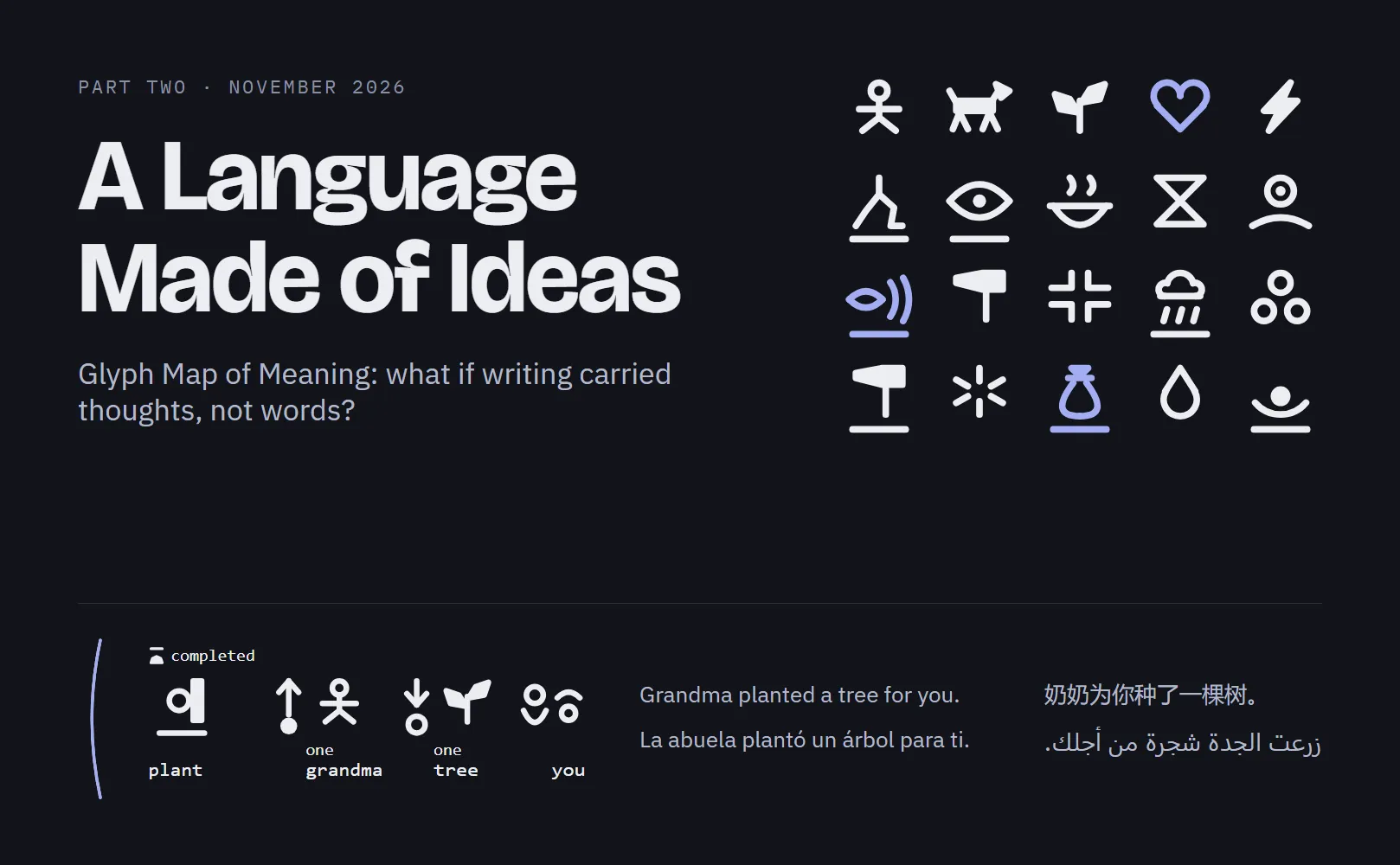
Somewhere a grandmother plants a tree. Say it in English, Chinese, Spanish or Arabic and you get four different strings of sound and ink. The event is the same. So is the thought.
What would it take to write the thought itself?
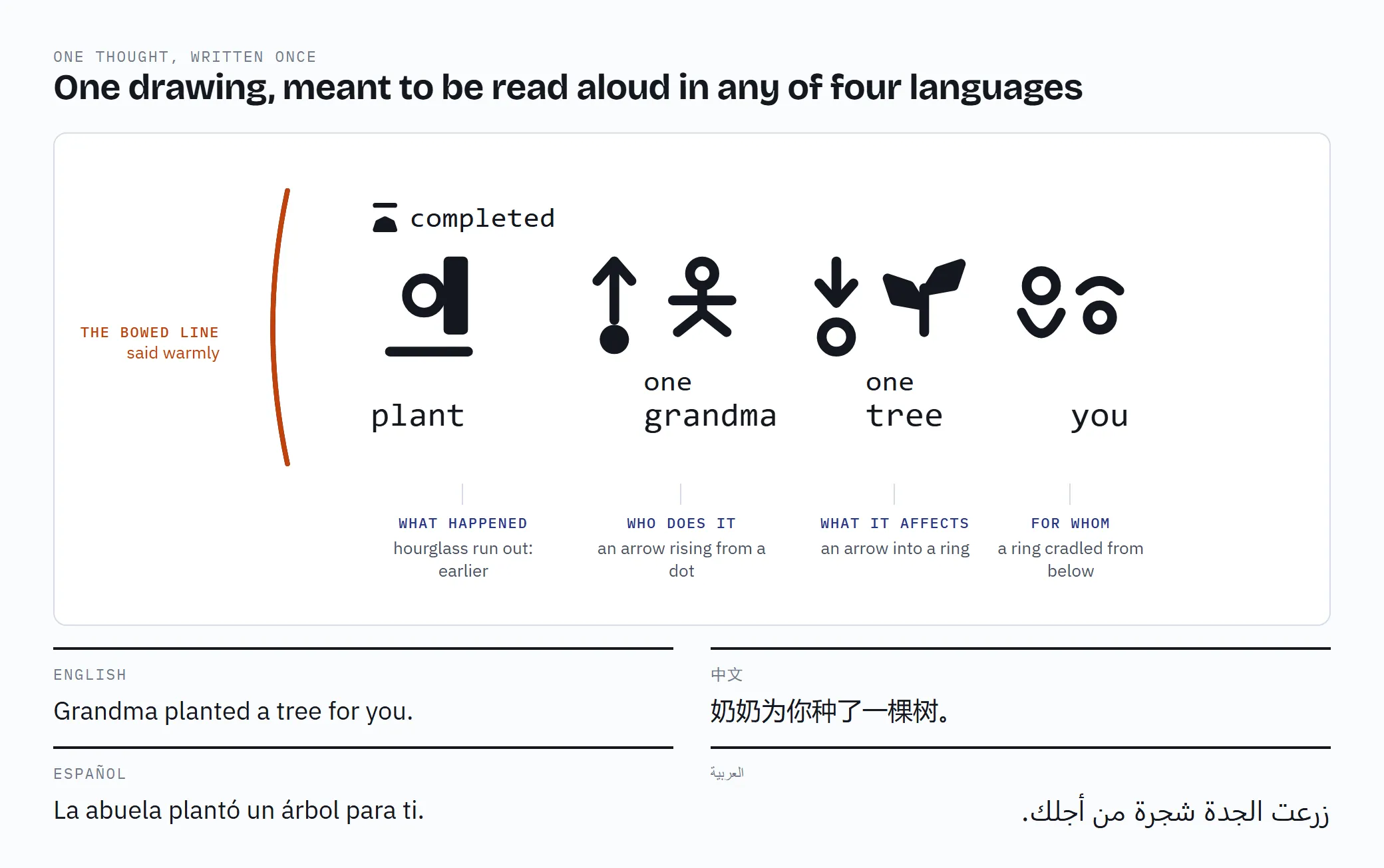
The drawing above is our answer so far. It is not a sentence in any language. The aim is that it can be read aloud in all of them. An arrow rising from a dot marks who acts. An arrow dropping into a ring marks what is acted on. An hourglass with its sand run out says it happened earlier. The long curve in the margin says it was said warmly. For now the idea itself is written under each sign as a word, here in English. The signs say what kind of thing it is and what part it plays.
Our first attempt was much simpler, and it failed. We asked whether a whole sentence could be squeezed into a single symbol and read back out by a small AI model. It could not. The symbol kept the topic and lost the plot: who did what to whom.
That failure sent us back to the history of writing. Egyptian scribes, the makers of Chinese characters and the designers of the Korean alphabet each found part of the answer. You do not need a picture for everything. You need signs that combine by rule, and the discipline to let position carry meaning.
This is the story of the second design: a script of 96 signs, a dictionary of more than 100,000 ideas, a grammar made of distance, and marks for tone of voice. It is still a design. No model has been trained on it and no person tested. Below is what we have built, what building it has taught us, and what is still unproven.
More like this
- Glyph Map of Meaning: first results
Can one symbol carry a sentence's meaning across four languages, and can a small model read it back? What held up in the first round, what didn't, and what I'd change.
The Aeon Forge10 min read - Where Uncensored Models Come From
I counted 3,352 uncensored releases of three base models and read their public weights. 177 are distinct work. What the rest are, what a fresh edit takes, what mine cost, and what the next one needs.
The Aeon Forge11 min read - DDTree on vLLM: candid research notes on tree speculation for Qwen3.6
DDTree puts tree-shaped speculative decoding into vLLM for Qwen3.6 on a DGX Spark. These lab notes show what works, what breaks inside a hybrid attention model, the numbers so far, and why production should stay on DFlash.
The Aeon Forge8 min read